“I want to know I’m doing absolutely everything I can to preserve my health for as long as possible.”
We hear this kind of thing a lot.
People tell us they not only want to stay in good shape as they age, they also want to outlive their peers and age expectancies.
Imagine you could maximize your healthspan and lifespan, fend off disease, and generally remain fit, lean, and youthful into your 90’s, 100’s, and then some.
Sounds pretty compelling, doesn’t it?
There’s just one problem: Common longevity advice seems to involve an extraordinary amount of effort. And time. And money. And complexity.
Is all the effort necessary? Is it worth it?
And, will it even work?
In this article, we’ll explore
- The biggest myths—and realities—about optimizing your health
- The real costs and tradeoffs of “optimizing” your health
- What’s actually required to improve your healthspan and lifespan
- Why enjoying your life isn’t separate from good health; it’s part of it
And, we’ll help you weigh the pros and cons so you can make informed decisions about your health, your body, and your life.
The myths—and realities—of “optimizing” your health
Health and longevity advice is everywhere these days: podcasts, books, social media, that guy at the gym…
Plus, influential “figureheads” have given the movement outsized attention. Think: popular podcasters and health experts Dr. Peter Attia, Dr. Andrew Huberman, and Dr. Rhonda Patrick, and biohacker Bryan Johnson.
We understand the appeal of this kind of content. Who doesn’t want a longer, healthier life? (Not to mention the comforting sense of control that can come from designing and executing a “perfect” health plan.)
But for us at PN, where we’ve collectively coached hundreds of thousands of people with real human lives, we know that “optimal” is rarely realistic.
Not only that, optimal isn’t necessary.
Making modest, relatively consistent efforts towards health and well-being will likely give you better results than following an intense, highly “optimized” protocol.
If that sounds hard to believe, we get it. So let’s explore that bold statement, starting with the biggest myths surrounding longevity and health optimization.
Myth: The “basics” aren’t enough.
There’s an idea that getting and staying healthy must require a set of complex, “cutting edge” strategies—especially if your goal is to outlive the average American.
In reality, the “basics” work really, really well. (These are things like exercising regularly; eating a nutrient-rich diet; getting adequate sleep; managing stress; and staying socially connected. We’ll discuss these more later.)
Only, particularly few people do the basics consistently.
The real reason more people aren’t living as long, or as well, as they could be isn’t because they’re not taking ice baths or getting vitamin C infusions…
It’s because they’re not doing the (relatively) simple stuff, consistently.
If you’re really, truly doing a well-rounded set of health-promoting behaviors with 80-90 percent consistency, you’re probably already close to peak optimization.
Myth: More is better
If a handful of basic behaviors get results, then doing them perfectly and as much as possible will help you get, and stay, even healthier—right?
Not so fast. There’s a law of diminishing returns when it comes to health and fitness efforts.
Plus, in our experience, doing too many things or adding in too much complexity to your health and fitness regime can:
- Add risk factors that could actually make your health and fitness worse (such as chronic injuries or burnout due to overtraining, and/or nutrient deficiencies or disordered eating due to an over-preoccupation with “clean” or restrictive eating).
- Make it harder for you to sustain good habits. People who take on too much are more likely to burn out. Research shows people who try to accomplish multiple goals are less committed and less likely to succeed than those focused on a single goal.1
- Make your life less enjoyable, which in turn compromises health. Striving to maximize physical health can interfere with mental, emotional, and social well-being, which plays an essential role in healthspan and lifespan. (One study showed people with high levels of happiness and life satisfaction lived up to 10 years longer than people with low levels.2)
And what’s the point of living longer if you’re not living a full, well-rounded, enjoyable life? While some effort is definitely important, past a certain point, more isn’t necessarily better.
Myth: Cutting-edge strategies offer significant benefits.
Let’s say you could put all those advanced, complex strategies into action without sacrificing consistency or life enjoyment, or compromising your overall well-being.
They’d have to pay off, wouldn’t they?
Not necessarily.
Much of the research on longevity optimization (so far) is either in mice, is observational, is theoretical, or has been tested on particularly small numbers of people for particularly short periods of time.
In fact, many of the fringe methods and supplements touted by influencers or biohackers are not only unproven but even potentially unsafe.3 4 5 6
Point being: Put your efforts towards foundational health behaviors with proven track records (the kind we’ll cover in this article) before you invest in fringe efforts.
Myth: It’s all or nothing.
You might think, “Well, I’m not getting out of bed at 5 a.m. five times a week to go running for 60 to 90 minutes to optimize my VO₂ max, so I may as well just accept I’m not going to be a healthy person.”
Some folks feel overwhelmed by the idea of optimizing their health, so they figure they might as well do nothing.
However, our internal data shows that you can be far from “perfect” to get results.
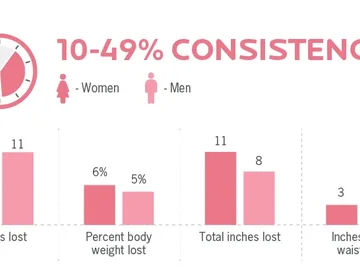
In our year long PN Coaching program, even clients who practiced their (basic) habits less than half of the time got measurable results.
(Read more: Nearly 1 million data points show what it REALLY takes to lose fat, get healthy, and change your body)
Don’t let optimization culture convince you great health is beyond your capabilities.
Instead, we encourage you to…
- Consider your options. Review the facts, and get a clear understanding of which behaviors are most likely to give you the best bang for your buck.
- Get clear on the tradeoffs. Decide which things you are, and aren’t willing to commit to.
- Make decisions that align with your goals. Including what kind of lifestyle you want, and how you want to spend your time and dollars.
Keep reading and we’ll guide you through it.
The benefits—and tradeoffs—of a healthy lifestyle
Putting effort towards your health is great. But efforts come with tradeoffs.
Here’s a look at both the efforts, and the tradeoffs, to achieve the health you want for yourself.
Take The Longevity Assessment
How do your health and longevity efforts stack up? What can you do to make the biggest difference? Take The Longevity Assessment and find out! To begin, simply click “Get started” below.
A deeper look: The most effective health behaviors (and their optimal dose)
If you want to reduce your risk of chronic disease, and generally stay healthier for longer, what should you do?
As we said earlier, the issue isn’t that we need some highly detailed, cutting-edge protocol. The basics work. The issue is that most people don’t do them.
For example, as shown in the image below, most people don’t get enough fruits and veggies, sleep, or exercise. And the number of people who do all these things on a regular basis (while also avoiding tobacco and minimizing alcohol) is extremely low: likely a fraction of a percent.
Finally, let’s take a closer look at what these basics are, and the “sweet spot” of effort versus reward.
Foundational Health Behavior #1: Exercise regularly
All health experts agree: Moving your body is important.
Yes, exercise will help you stay lean, and improve mood, energy, and function, but it will also help you stay alive (and healthier) for longer.
In fact, a study of Harvard alumni found that any amount of physical activity reduces the risk of death from any cause. Exercise extended lifespan regardless of body weight, blood pressure, smoking habits, or genetic predisposition.7
Another study of 272,550 older adults found engaging in even low amounts of physical activity significantly decreased risk of death from cancer, cardiovascular disease, and all causes.8
Specifically, steep risk declines happened when accumulating at least 7.5 MET-hours* of activity per week. The greatest increase in benefits came from achieving 7.5 to 15 MET hours. Increasing activity beyond that further decreases risk, but at a continually lower rate, as the graph below shows.
*MET-hours (Metabolic Equivalent Hours) measures the energy cost of activity, based on duration and intensity. Some examples: 2 hours of resting = ~2 MET-hours; 2 hours of moderate-intensity aerobic activity = ~8 MET-hours; 2 hours of moderate resistance training = ~7 MET-hours.
Increasing the intensity of exercise is an efficient way to rack up MET-hours, but plain old walking counts too: In a study of 28,000 adults, every 1,000 daily step increase was associated with a 12 percent lower risk of death. (This association began at 2,500 steps and continued up to 17,000 steps.)9
(Cool factoid: For folks concerned with dementia in particular, one study showed that getting just 3,826 steps per day was associated with a 25 percent reduced risk of dementia—and getting 9,826 steps per day was associated with a 50 percent lower risk!10)
Ideally, cardiovascular activity is paired with resistance or weight-bearing exercise.
Resistance training supports health and longevity in various ways: it can help preserve valuable muscle mass, maintain mental sharpness, improve odds of surviving cancer, support metabolic health, and generally help you stay alive.11
Among older adults especially, falls are a leading cause of death.12 Resistance training can both prevent the risk of falls–because of improved balance and muscle stability13—as well as reduce the risk of serious injury–because of better bone density.14
A sedentary lifestyle does the opposite, increasing risk of cardiovascular disease, diabetes, hypertension, cancer (breast, colon, colorectal, endometrial, and epithelial ovarian cancer), and all-cause mortality.15
In fact, two decades of sedentary lifestyle is associated with twice the risk of premature death compared to being physically active.16
▶ How much exercise should you do?
Standard exercise recommendations suggest:17
- 150 minutes per week of moderate-intensity aerobic activity, or 75 minutes per week of vigorous aerobic activity (or some combination of both), plus
- 2 sessions per week of resistance training, targeting most major muscle groups
Getting up to 300 minutes per week of moderate-intensity or 150 minutes of vigorous-intensity aerobic activity (or some mix of both) as well as three resistance training sessions per week provides further benefits.
▶ Are people getting enough exercise?
Most people are not.
Only 24 percent meet the recommendations for both aerobic and resistance exercise. And fewer than 47 percent of American adults meet recommendations for aerobic physical activity.17
▶ Is getting more than the recommended amount better?
For the most part yes, but past a certain point, more effort delivers less benefit—and potentially more risk.
Overtraining (and/or under-recovering) can disrupt hormone levels, mess with sleep and mood, cause excess fatigue, chronically elevate your heart rate, cause injuries, and more.18 19 Extreme volumes of endurance exercise training may be detrimental for the heart, and increase risk of myocardial fibrosis, coronary artery calcification, and atrial fibrillation.20 21 22 23
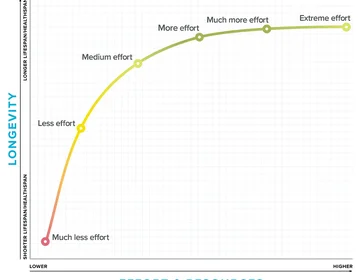
So, the benefits of exercise exist on a U-shaped curve. (This is known as the “Extreme Exercise Hypothesis,”24 as seen in the image below.)
A “high” amount of exercise is good for you, but the “highest” amount possible probably isn’t. (Health benefits likely max out around 7-10 hours of cardio, and 3-4 resistance training sessions per week.)
We like what one study concluded: “If the mantra ‘exercise is medicine’ is embraced, underdosing and overdosing are possible.”25
Foundational Health Behavior #2: Eat a nourishing, nutrient-rich diet
Eating well doesn’t have to be complicated. There are a few key elements to nail down, and the rest is up to your own personal preferences and needs.
We suggest focusing on three nutrition fundamentals.
Nutritional key #1: Eat more whole and minimally-processed foods
Whole and minimally-processed foods are naturally nutrient rich—complete with fiber, healthy fats, vitamins, minerals, and phytochemicals—and far less calorie-dense than highly- or ultra-processed foods (UPFs). They also have less sugar, sodium, and trans fats—the latter which is directly linked to an increased risk of cardiovascular disease, breast cancer, complications during pregnancy, colon cancer, diabetes, obesity, and allergy.26 27 28
These qualities contribute to their many health benefits; Diets rich in whole or minimally-processed foods are associated with lower rates of depression,29 30 31 heart disease,32 type 2 diabetes,33 cancer,34 and improved longevity.35
The largest study on processed foods—which included almost 10 million participants—found UPFs are linked to 32 harmful effects, including type 2 diabetes, mental health disorders, obesity, cardiovascular disease, and all-cause mortality.36
Another study found that a higher consumption of ultra-processed foods (four or more servings daily) was associated with a 62 percent increased risk of all-cause mortality. (For each additional serving of ultra-processed food, all-cause mortality increased by 18 percent.)37
Not that you need to be plucking tomatoes straight off the vine.
Eating a minimally processed food diet is more about overall dietary patterns—and moving along the continuum of improvement—rather than rigidly avoiding all forms of processing.
▶ How many minimally-processed foods should you eat?
There currently aren’t any formal guidelines for the amount of minimally-processed foods to eat. In our experience coaching over 100,000 clients, we find people are most satisfied, and get significant health improvements, when 70 to 80 percent of their diet comes from whole or minimally-processed foods.
Any improvement counts though. If you’re currently eating particularly few whole and minimally processed foods, getting at least 50 percent of your diet from these foods would make a big difference to your health, energy, and longevity.
▶ Are people eating enough minimally-processed foods?
No.
Recent US data shows that Americans get about 28.5 percent of their calories from whole or minimally-processed foods, and 56 percent of their calories from highly- or ultra-processed foods.38
▶ Is getting more than the recommended amount better?
Not beyond a certain point.
If you want to, consuming up to 90 percent of calories from minimally-processed foods will truly maximize your benefits, but beyond that there are likely no further benefits.
Besides, some processed foods enhance health rather than detract from it. Think about the protein powder that helps you meet your protein requirements, the commercial salad dressing that helps you eat your vegetables, or the weekly brownie à la mode you share with your grandkid that brings joy to both of your lives.
(Read more: What you should know about minimally-processed foods vs. highly-processed foods)
Nutritional key #2: Eat five fruits and vegetables
You’ve heard it a million times. We’ll be the nag and say it again: Eat your fruits and veggies.
A massive study involving over 1.8 million people showed that eating more fruits and vegetables was significantly associated with a decreased risk of death—with the benefits plateauing at five servings a day. People who ate five servings a day had a 13 percent lower risk of death from any cause compared to people who ate two servings per day.39
Additionally, the consumption of